
Category: Industry Trends
Source Tagging Is Becoming a Strategic Priority for Retailers
Retailers today face increasing pressure to protect merchandise, improve inventory accuracy, streamline store operations, and deliver a consistent shopping experience. As retail supply chains become more complex, source tagging is gaining importance as a practical approach to integrating product protection into the manufacturing and distribution process.
Source tagging refers to the process of applying security labels, tags, or other product identification solutions at the source, such as a factory, packaging facility, or distribution center, rather than waiting until merchandise reaches a retail store.
For apparel brands, department stores, supermarkets, pharmacies, and other retailers, source tagging can help reduce repetitive in-store handling and establish a more consistent approach to merchandise protection.

In 2026, several developments are making source tagging solutions increasingly relevant to retail operations.
1. Earlier Integration of Retail Security into the Supply Chain
Traditional retail security processes often require store employees to attach security devices after products arrive. When retailers handle large volumes of merchandise, this additional step can consume labor and complicate store operations.
Source tagging moves this process upstream.
By applying compatible EAS security labels, tags, or other protective devices during manufacturing or packaging, businesses can prepare merchandise for retail distribution before it reaches the store.
Potential benefits include:
– Reduced repetitive tagging work in retail stores.
– More standardized product protection across locations.
– Improved readiness for distribution and shelf replenishment.
– Better coordination between suppliers, manufacturers, and retailers.
The actual benefits depend on product type, tagging method, production volume, and supply chain processes. Retailers should evaluate source tagging as part of their broader operational strategy rather than as an isolated security measure.
2. RFID Source Tagging and Better Inventory Visibility
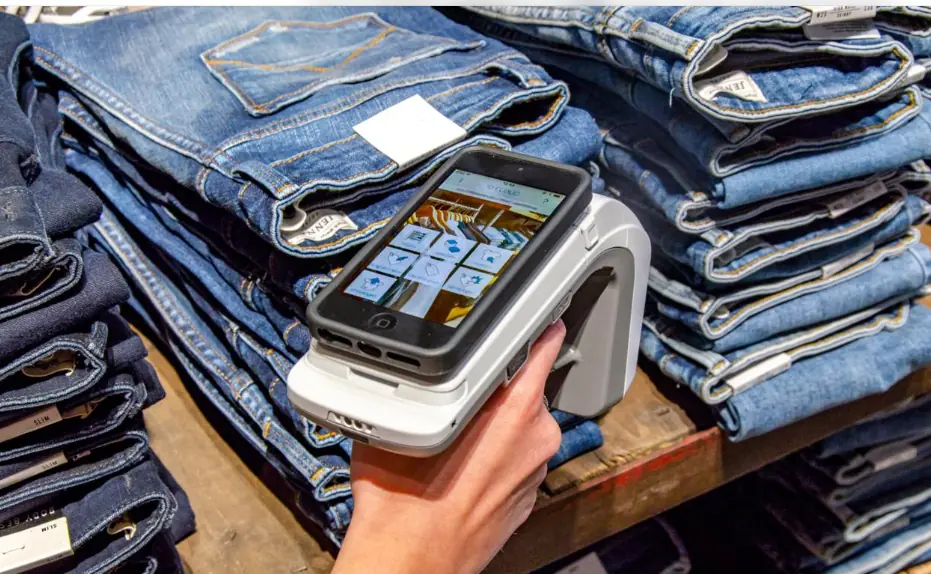
Radio-frequency identification (RFID) is an important technology in modern inventory management. Unlike conventional barcode scanning, RFID systems can identify compatible tagged items without requiring direct visual alignment between each tag and the reader.
When integrated into a suitable retail system, RFID source tagging can support item-level inventory visibility, stocktaking, replenishment, and merchandise tracking.
For apparel retailers, RFID labels may be integrated into product hangtags, care labels, or other suitable tag formats. This allows identification technology to be introduced earlier in the product lifecycle.
However, RFID and traditional electronic article surveillance (EAS) are not interchangeable in every application. RFID primarily supports identification and data capture, while EAS systems are commonly designed to help detect unauthorized removal of protected merchandise. Some solutions may support both functions, depending on their design and system compatibility.
Retailers should select the technology according to their operational requirements, infrastructure, and budget.
3. More Flexible Source Tagging Solutions for Different Products
One tagging solution rarely fits every product category.
Apparel, footwear, cosmetics, packaged goods, accessories, and other retail merchandise may require different security formats and attachment methods.
Examples include:
– EAS security labels: Suitable for compatible products and packaging where discreet protection is preferred.
– Hard security tags: Used for suitable merchandise requiring reusable physical security devices.
– RFID labels and hangtags: Designed for applications requiring electronic identification and inventory data.
– Customized security solutions: Adapted to product materials, packaging dimensions, brand requirements, and production workflows.
For high-volume manufacturers and retailers, the ability to select an appropriate tagging format can be just as important as the tag itself.
A practical source tagging program should consider attachment methods, product compatibility, production speed, packaging design, and performance testing.
4. Source Tagging Can Help Streamline Retail Operations
Labor efficiency remains an important consideration for retailers managing multiple stores and high product turnover.
When tagging is integrated into existing production or packaging workflows, stores may spend less time applying security devices manually. This can allow employees to focus more on customer service, replenishment, merchandising, and other store-level responsibilities.
The business case is particularly relevant when a retailer processes large quantities of similar products across multiple locations.
Before implementation, businesses should compare the total cost of source tagging with the cost of in-store tagging, including labor, equipment, quality control, packaging changes, and supplier coordination.
A well-planned program should be measured using practical indicators such as tagging accuracy, processing time, product compatibility, and overall operating cost.
5. Supplier Collaboration Is Essential to Successful Implementation
Source tagging works best when retailers, brands, manufacturers, and tagging suppliers coordinate their requirements early.
A retailer may have specific requirements for security technology, tag placement, packaging, testing, or distribution. If these requirements are communicated late, manufacturers may need to modify production processes or rework finished goods.
To improve implementation, businesses should establish clear specifications covering:
1. Product categories and tagging requirements.
2. Tag or label dimensions and attachment methods.
3. Compatibility with existing EAS or RFID infrastructure.
4. Quality inspection and sample approval procedures.
5. Packaging, shipping, and production scheduling.
6. Volume forecasts and reorder arrangements.
Working with an experienced source tagging supplier can help businesses assess these requirements before moving to large-scale production.
How to Choose the Right Source Tagging Supplier
Selecting a source tagging supplier involves more than comparing unit prices. Buyers should evaluate product quality, manufacturing capabilities, customization options, lead times, communication, and technical support.
Before placing a bulk order, consider asking the supplier:
– Which EAS or RFID tagging options are available for my product category?
– Can the solution be customized to our packaging or production process?
– Is sample testing available before mass production?
– What quality-control procedures are used?
– What are the minimum order quantities and typical lead times?
– Can the supplier support repeat orders and changing demand?
These questions can help procurement teams identify a suitable long-term partner and reduce avoidable implementation risks.
Conclusion: Build a Smarter Source Tagging Strategy
Source tagging is an increasingly relevant approach for retailers seeking to integrate product protection into their supply chains. By evaluating EAS security tags, RFID identification solutions, and customized tagging formats, businesses can develop processes that better align with their operational requirements.
The most effective solution depends on the merchandise, retail security system, production environment, and total cost of implementation.
For brands, manufacturers, and retailers planning a new source tagging program, early supplier collaboration and product testing are essential steps toward a reliable result.
Looking for a reliable source tagging supplier? Contact Allytag to discuss your product requirements, tagging options, customization needs, and bulk order specifications.